

Yield Variance: Definition, Formula & Example
Updated on April 25, 2023 | 1 min. read


🌟 KEY TAKEAWAYS

Yield variance quantifies the discrepancy between a production or manufacturing process's actual and expected output.
It is the opposite of mix variance, which is the variation in total material utilization.
If a company overestimates or underestimates how much material is required to produce a specific amount, yield variance will be above or below zero.
Read on as we take a deeper look at yield variance, as well as the formula used, what it indicates, and answer some of your frequently asked questions.
What Is Yield Variance?
Yield variance is the difference between a production or manufacturing process's actual and expected outputs, calculated using standardized inputs for labor and materials. The yield variance is valued at standard cost. Yield variance, when the actual output is smaller than the standard or expected output, is typically unfavorable, while it is possible that the output exceeds expectations as well. Yield variance measures the effectiveness of the manufacturing process.


Formula to Calculate Yield Variance
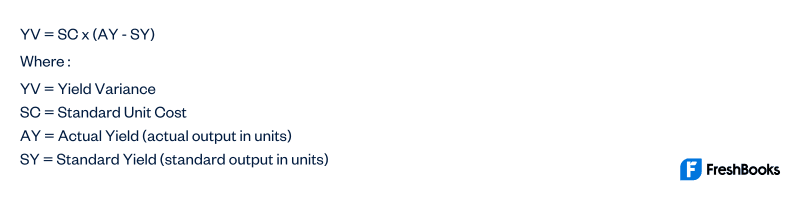
The formula to calculate yield variance is as follows:
What Does Yield Variance Indicate?
Yield variance is a common financial and operational measure in the manufacturing sector. It's pretty common for an analyst to change inputs for unique scenarios in order to enhance or improve the metric.
For instance, it might not be wise to employ temporary pricing inputs that experience brief price spikes during a raw material price surge because the results might deviate from expected levels. Like any other analysis, this one involves both art and science, and requires a certain degree of a professional judgment


Example of Yield Variance
If the standard output for a product is 500 units and the actual yield is 490 units after an 8-hour manufacturing unit, there is a negative yield variance of 10 units (500 - 490). The standard cost is $2.50 per finished product. So using the above formula, we can calculate the yield variance as follows:
YV = 2.50 x (500 - 490)
YV = 25
So the yield variance would be $25.
Summary
Yield variance is a useful tool in the manufacturing industry. However, it’s important to note that while yield variance may indicate whether or not your output is effective or as anticipated, it is unable to explain why the variance happened or what factors may have contributed to it.


FAQs on Yield Variance